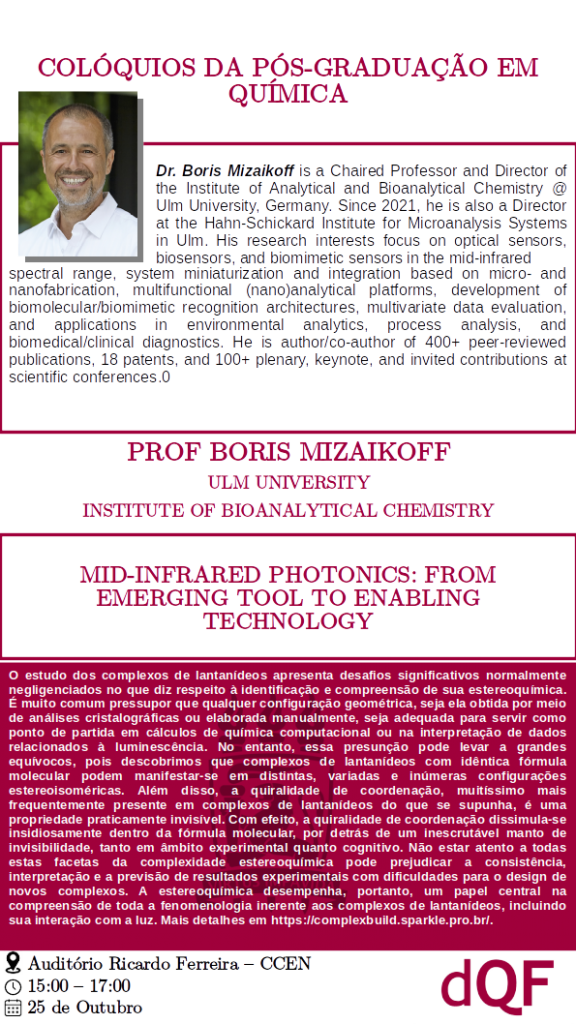
Diretor do Institute of Bioanalytical Chemistry, da Universidade de Ulm (Alemanha), o professor Boris Mizakoff participa dos colóquios da Pós-Graduação em Química. Sensores ópticos, biossensores e sensores biomiméticos na faixa espectral do infravermelho médio estão entre os interesses do pesquisador, que apresenta a palestra “Mid-infrared photonics: from emerging tool to enabling technology”, amanhã (25), das 15h às 17h, no Auditório Ricardo Ferreira, que fica no Centro de Ciências Exatas e da Natureza (CCEN) da Universidade Federal de Pernambuco (UFPE).
Resumo em inglês
Vibrational spectroscopies – and especially infrared spectroscopy – play an increasingly important role in modern biodiagnostics, environmental analysis, and food safety/quality scenarios. This has led to the evolution of mid-infrared photonics from an emerging tool into an enabling technology. With applications ranging from non-invasive exhaled breath analysis to in-vivo assessment of cartilage damage, mid-infrared (MIR; 3-20 µm) photonics ranges among the most flexible molecular sensing platforms nowadays available. In particular, with the emergence of quantum and interband cascade laser technology, the on-chip hybridization and/or integration of entire MIR sensing devices is on the horizon ultimately leading to IR-lab-on-chip systems. The inherent molecular selectivity of MIR signatures enables studying small molecules (e.g., volatile organic compounds; VOCs) in the gas phase, as well as biomacromolecules (e.g., proteins) in the liquid phase at unprecedented detail in a label-free and non-destructive fashion. Last but not least, the combination with advanced multivariate data evaluation and deep learning algorithms facilitates analyses in real-world complex mixtures in a wide range of demanding scenarios. The discussion of latest MIR photonic technologies in this presentation we will be augmented by highlight applications underlining the utility of next-generation MIR photonics.
Mais informações
Departamento de Química Fundamental da UFPE
(81) 2126.8444
secgdqf@ufpe.br